

The Future-Proof Technologist: Why Your Job Isn't Disappearing, It's Evolving
How to Build an AI-Resistant Career While Everyone Else Panics About Replacement

The panic is real.
IT professionals (and CIOs alike) are asking the hard questions: Will AI replace developers? Are CIOs becoming obsolete? Is this the end of IT as we know it?
Here's the rebel truth: Your job isn't disappearing. It's evolving. And the technologists who understand this first will inherit the digital kingdom.
While everyone else is wringing their hands about AI taking over, the smart money is on becoming the human who makes AI unstoppable. Welcome to the playbook for future-proof rebel technologists.
The Great IT Anxiety: Missing the Forest for the Trees
The headlines scream displacement. And a great piece by Isaac Sacolick reaffirms this.
You’ve got Boris Cherny from Anthropic claims Claude is writing nearly 80% of their code. Then, Satya Nadella estimates AI writes 20-30% of Microsoft's code.
CIOs are wondering if CEOs still need them when AI can generate applications from prompts.
But here's what the panic merchants miss: Every technological revolution creates more jobs than it destroys. It just demands different skills.
As Martin Davis, CIO and managing partner at Dunelm Associates, puts it: "We've seen this in the past with outsourcing and other cycles, and we find that we do need IT, but the role of IT does change and evolve."
The rebel technologist doesn't fear this evolution. They orchestrate it.
The Karpathy Revelation: English as the Ultimate Programming Language
Andrej Karpathy dropped a truth bomb that should fundamentally rewire how you think about your career: "English is the hottest programming language."
This isn't just a clever soundbite. It's a roadmap to irreplaceability.
In Software 3.0, prompts become programs.
The keyboard warriors of yesterday become the prompt engineers and vibe coders of tomorrow. But here's the nuance everyone misses: mastering English as a programming language isn't about writing better prompts, it's about becoming a translator between human intent and machine capability.
The Iron Law of Future-Proofing: When you amplify your cognitive leverage through AI, you don't just get more productive, you become more creative, more strategic, and more indispensable.
In fact, Mo Gawdat recently dropped an interesting bomb: AI can give you up to 60 IQ points.
The Symbiosis Strategy: Why Replacement Thinking is Amateur Hour
The amateur technologist asks: "Will AI replace me?"
The rebel technologist asks: "How can I become the human that AI can't function without?"
Dr. Joanne Friedman, CEO of Connektedminds, nails the opportunity: "AI is a catalyst for the IT organisation to become what it has needed for a long time, to go well beyond having a seat at the table and become a business unit strategically important to the organisation. And this is also what will take the CIO to a CEO role."
This is the paradigm shift: AI doesn't eliminate the need for technologists, it elevates the ones who master human-AI collaboration.
Look at the real-world evidence:
Harry Roper at Lovable tripled his solo SaaS revenue by leveraging AI for everything from backend logic to customer onboarding
17-year-old Rexan Wong built an app reaching 400,000 users using AI-enhanced workflows
Solo creatives like Ehud Basis run entire ad agencies using ChatGPT, CapCut, and Colossyan while maintaining creative control
The pattern? These aren't stories of replacement, they're stories of amplification.
The Five Pillars of Future-Proof Technology Careers
1. Master the Generation-Verification Loop
The secret sauce isn't perfect AI, it's optimising the speed at which you can evaluate and iterate on AI output.
Real-world example: Legal teams using AI to draft contracts focus on rapid review and refinement. The AI generates, humans verify and guide. Result? Contract review that took weeks now takes hours, but with higher quality.
Your action item: Build systems that make AI output validation intuitive and rapid. The faster your feedback loop, the more powerful your partnership.
2. Embrace the Psychological Quirks (Don't Fight Them)
AI systems exhibit what Karpathy calls "jagged intelligence", they can solve complex mathematical proofs while failing to correctly compare 9.11 and 9.9. They suffer from "anterograde amnesia," brilliant in the moment but unable to remember your last conversation.
The rebel approach: Design workflows that complement these characteristics rather than working around them. Use AI's strengths ruthlessly while building human oversight into its blind spots.
3. Become an Autonomy Orchestrator
The future belongs to professionals who can seamlessly adjust AI autonomy levels based on context. Think Tesla's Autopilot levels 1-4, or Cursor's "autonomy sliders" from tab completion to full agent mode.
Your differentiator: Learn to conduct an orchestra of AI capabilities rather than playing a single instrument.
4. Think Ecosystem, Not Efficiency
Linear thinking kills exponential opportunities.
Don't optimise existing processes. Reimagine them entirely. Ask: "What becomes possible when intelligence is infinite and instantaneous?"
As Dominik Angerer, CEO of Storyblok, explains: "AI won't replace agile or DevOps - it'll supercharge them with standups becoming data-driven, CI/CD pipelines self-optimizing, and QA leaning on AI for test creation and coverage. Developers shift from coding to curating, business users will describe ideas in natural language, and AI will build functional prototypes instantly."
5. Automate Yourself First
The rebel's golden rule: Don't wait for others to automate your job. Build the AI that makes you irreplaceable.
If your tasks can be done by AI, be the one who builds that AI. Own the automation, don't become its victim.
The Skills That Will Matter in 2030
While everyone else is learning the latest framework, future-proof rebels are developing these meta-skills:
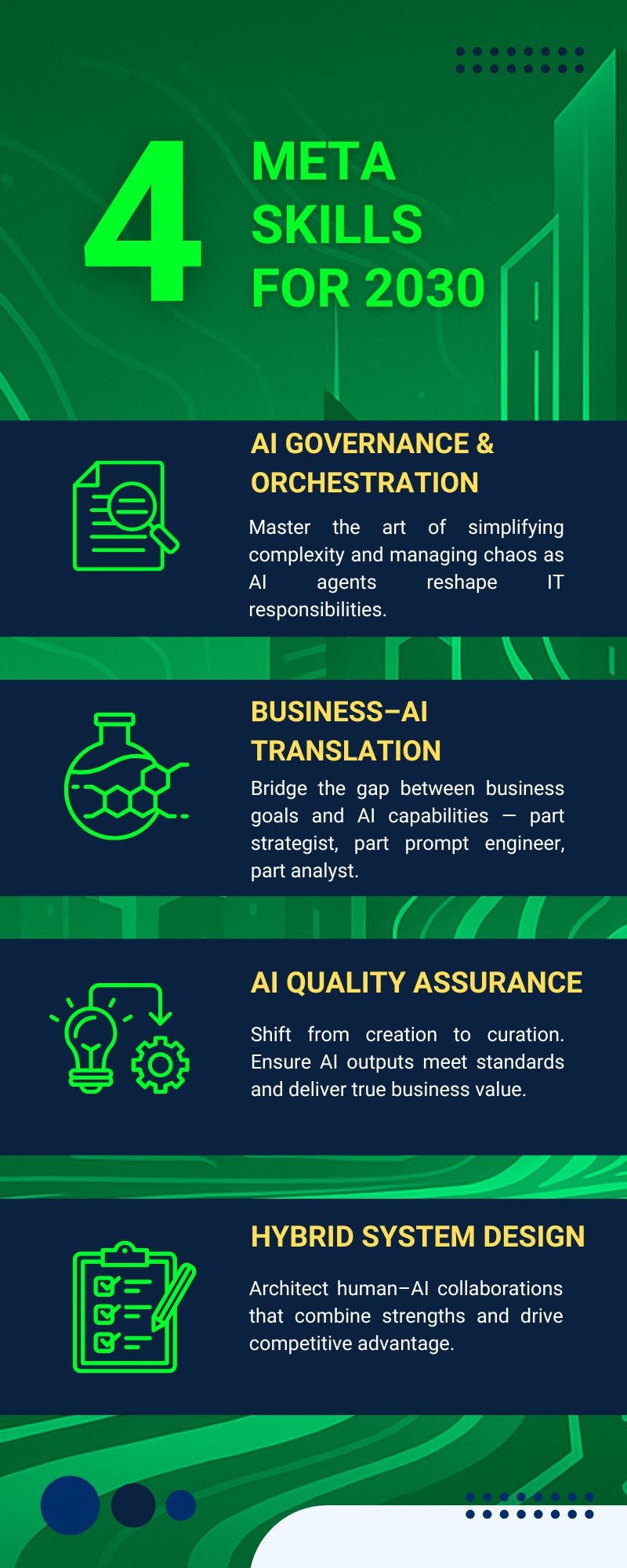
AI Governance and Orchestration
"Simplifying complexity and managing chaos has always been part of the IT charter, and that's not going to go away with the adoption of AI agents," says Rishi Bhargava, co-founder of Descope. The shadow AI problem will create new IT responsibilities.
Business-AI Translation
The most valuable professionals will bridge the gap between business intent and AI capability. Think product manager meets prompt engineer meets business analyst.
Quality Assurance for AI Systems
As Marcus Torres, chief product officer of Quickbase, notes: "Generative AI is redefining virtually every function within organizations by shifting the role of the workforce from creation to curation, and this includes IT." The future is about curating AI output, not creating from scratch.
Hybrid System Design
Building systems where humans and AI agents complement each other's strengths. The winners will architect these collaborations, not just participate in them.
The Network Effect: Why Early Adopters Win
Here's what the late adopters miss: Early AI adopters don't just get operational advantages, they get ecosystem advantages.
The AI agents, data patterns, and operational knowledge they develop create compounding returns over time.
Companies building agentic AI systems today become talent magnets. The best technologists want to work with cutting-edge technology, and these organisations will attract tomorrow's top talent.
(More on Agentic AI and where it’s going, here)
The Contrarian's Take: AI Will Create More Jobs Than It Destroys
Every automation revolution has followed the same pattern: initial displacement, followed by job creation at higher levels of abstraction.
The typewriter put scribes out of business but created millions of administrative jobs.
The internet eliminated travel agents but created e-commerce, social media management, and digital marketing careers.
AI will follow this pattern, but with one critical difference: the transition will happen faster than any previous technological shift.
Joe Puglisi, growth strategist and fractional CIO at 10xnewco, offers perspective: "I think back to the days when you wrote an assembly and it took a lot of time. We introduced compilers, higher-level languages, and now we have AI that can write code. This is a natural progression of capabilities and not the end of programming."
The Bottom Line: Adaptation or Extinction
The future doesn't belong to the AI-resistant or the AI-replaced. It belongs to the AI-augmented.
The companies surviving the next decade will be centaurs: human creativity, judgment, and emotional intelligence combined with AI's computational power and tireless execution.
The question isn't whether AI will change your industry. It's whether you'll be wielding it or watching others dominate with it.
The Rebel Technologist's Action Plan:
Start building today, not tomorrow - Every day you delay is competitive advantage lost
Master the autonomy slider - Learn to orchestrate different levels of AI independence
Optimise your verification loop - Speed of evaluation = partnership power
Think platform, not project - You're building the foundation for an AI-native career
Embrace controlled chaos - Innovation dies in committees, thrives in rapid iteration
The age of Software 3.0 isn't coming, it's already here. The rebel technologist doesn't wait for permission to join the revolution.
Stay human. Think bigger. Let the machines handle the rest.
The future belongs to those who stop asking if AI will replace them and start asking how they can become irreplaceable in an AI-powered world.
The choice is yours: evolve or become extinct. Choose wisely, the revolution waits for no one.